 |
| Floor Slinky |
The Floor Slinky
by Clair Zeisler
American, 1903 – 1991
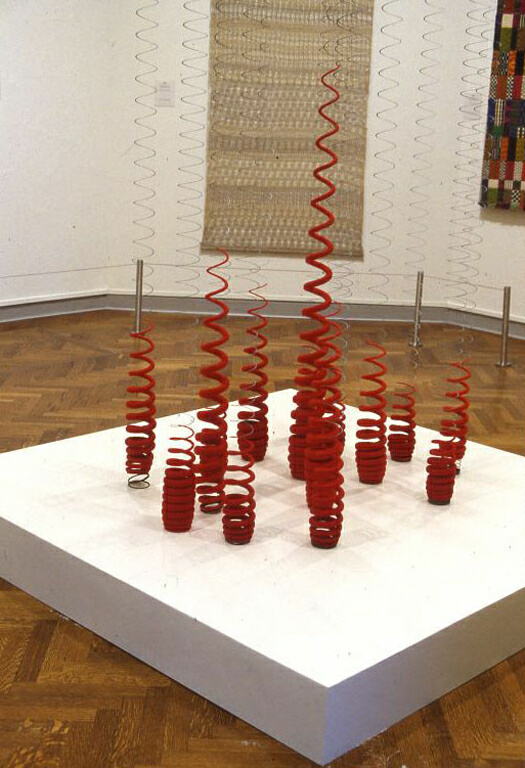
Floor Slinky: Thirty-two Elements, 1971
Cotton, polyester, and metal
Purchased with the aid of funds from the NEA and gifts from
Dr. and Mrs. Henry R. Hope and the Friends of Art 80.60
Clair Zeisler was a major figure in the fiber arts movement
of the 1960s. Her experimental fiber works include freestanding,
three-dimensional sculptural works such as Floor Slinky, which has been called
Zeisler’s “signature piece”.
The
Floor Slinky: Thirty-two Elements is basically a collection or arrangement of
red floor slinkies on a wood platform. The slinkies are made of metal but
wrapped in polyester and cotton. These slinkies are formed have conical shapes.
Then the slinkies are arranged in such a way that they somehow create a
formation of mountains alongside each other. Some slinkies are taller than the
other, the same as in mountain ranges.
But
these “mountain ranges” are not the ones you see in real life but rather the
ones you see used on fantasy films or cartoons. The “mountains” are typical of
those which depict the mountains on the fiery areas of hell. In other words,
imagine a formation of stalagmites which accidentally formed a picture of
mountain ranges in the depths of hell; or if you would, a picture of mountain
ranges in one of the fantasy films, such as seen in the Lord of the Rings. It
did not matter that the slinkies are more “perfect” in form since they are
perfectly formed cones; the whole effect of the formation is the same –
mountain ranges in hell. Nevertheless, the same as the stalagmites, there is
something quite appealing in the way they are formed. And in the sculpture, it
is more appealing since the formation created a place which the viewer can
easily find mysterious and yet easily recognizable.
Moreover, there is something more appealing
in the sculpture. This is in the use of the soft polyester and cotton materials
which gave the cones softer tones. The cones were given just the right degree
of softness to contrast with the mountain range effects and its red color.
Simply put, the softness of the cones are what made it beautiful. They gave the
whole sculpture its character. The softness created by the polyester and cotton
balanced the roughness of the formation. Instead of having just one rough piece
of mountain ranges, there is now a balance. In other words, the softness gave
it a feminine side; or now, there is something like a yin and yang balance in
the whole sculpture.
Although
I have described the mountain ranges as mountain ranges from hell, there is
nothing outright or blatantly sinister in the sculpture. The “mountain ranges
from hell” is not that obvious and this is because of the soft materials used.
In fact, the soft materials created the mysterious effect in the sculpture.
This is because they perfectly made the cones beautiful and they are the
perfect match to the rough, pointy, edgy mountain ranges. So as a whole, the
artist was able to make the sculpture is a perfect balance between soft and
rough, ugly and beautiful. As a result, the sculpture cannot be described as
beautiful or ugly but rather a stimulating piece which renders the viewer to
have ambivalent feeling about it, depending on the time or the mood of the
person at the time he is viewing it.

No comments:
Post a Comment